
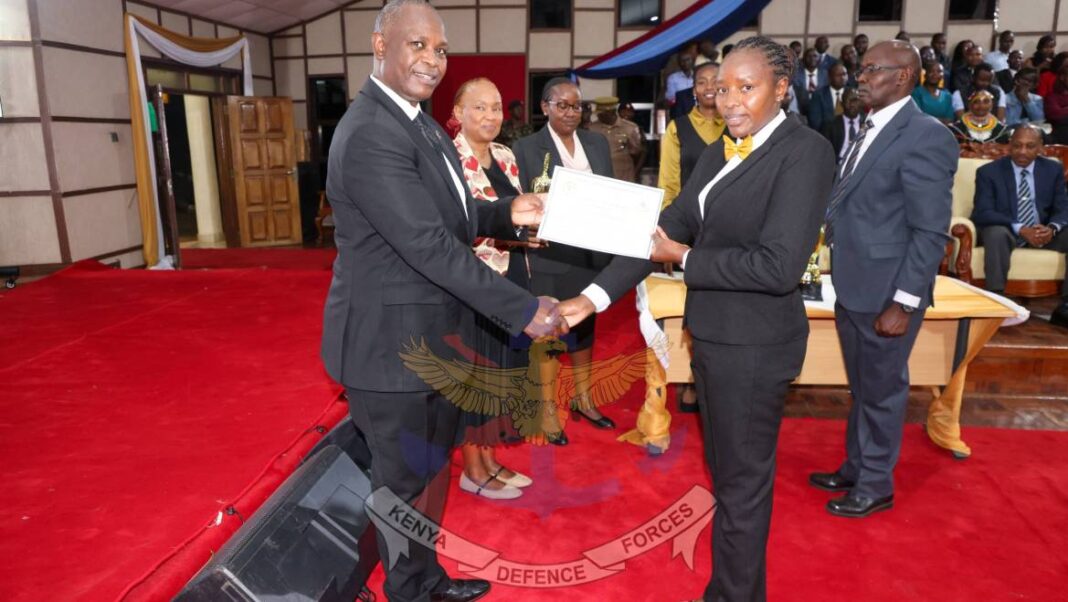

Military healthcare has been placed at the centre of Kenya Defence Forces (KDF) operational readiness, with newly trained health professionals urged to combine technical competence with discipline, resilience and compassion in safeguarding the lives of service personnel.
The call was made as the Defence College of Health Sciences (DCHS) held its 2026 Candle Lighting Ceremony and Nurses’ and Midwives’ Pledge at Lang’ata Garrison, marking the completion of the trainees’ programme and their transition into professional healthcare practice.
The ceremony brought together graduands, instructors and invited guests, while highlighting the critical role of military health personnel in maintaining the health and operational effectiveness of KDF personnel during both peacetime and military operations.
Presiding over the ceremony, National Defence University-Kenya (NDU-K) Vice-Chancellor Lieutenant General David Tarus challenged the graduates to apply the knowledge and skills gained during their training with professionalism, discipline and dedication across KDF medical establishments.
He emphasised that effective medical support is essential to sustaining troops operating in demanding and often unpredictable environments.
“Mission readiness depends heavily on the quality, preparedness and professionalism of our medical personnel. This places a profound responsibility on the Defence College of Health Sciences to prepare professionals who possess not only technical competencies, but also the resilience, discipline and commitment demanded by military service,” Lieutenant General Tarus said.
He noted that military healthcare professionals carry a significant responsibility because their preparedness and competence directly contribute to the resilience and effectiveness of personnel deployed in diverse operational environments.
The Chief Executive Officer of the Nursing Council of Kenya (NCK), Dr Lister Onsongo, urged the graduates to pursue continuous professional development and avoid complacency as they advance in their careers.
She encouraged them to embrace evidence-based practice, clinical research, and innovation to strengthen their capacity to respond to emerging healthcare challenges and developments in medical practice.
A key moment of the ceremony was the lighting of candles, symbolizing knowledge, compassion, and service. The ceremony was followed by the Nurses’ and Midwives’ Pledge, during which the graduands affirmed their commitment to professional ethics, integrity, dignity and quality healthcare.
The ceremony marked more than the completion of formal training, signalling the beginning of greater responsibility for the new healthcare professionals. Their roles will require them to balance the demands of healthcare with the discipline and operational requirements of military service.
DCHS, whose vision is to become a centre of excellence in medical training and research for national security and strategy, continues to prepare healthcare professionals to meet the evolving medical needs of the KDF.
Its training is anchored on integrity, creativity, discipline, stewardship, compassion, collaboration and dignity—values intended to guide graduates in their professional and military service.
As the graduates begin their assignments, the candle-lighting ceremony served as a reminder of their professional obligation to preserve life, provide compassionate care and maintain high standards of healthcare in support of the KDF and the nation.



