
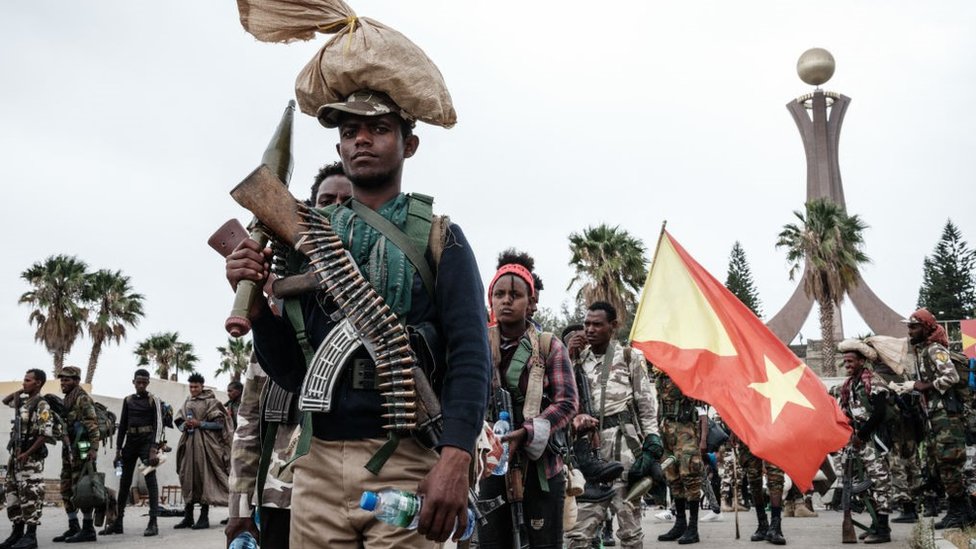

Ethiopia is facing its most serious security crisis in northern Tigray since the 2022 peace agreement, after Tigrayan forces reportedly seized control of airports in Mekelle, Axum and Shire, prompting Ethiopian Airlines to suspend flights to the region and raising fears that the two sides could be heading back towards open warfare.
Ethiopian Airlines confirmed the suspension of flights to the three Tigray airports on Wednesday, September 23, amid escalating tensions between Tigrayan forces and Ethiopia’s federal authorities. Reuters reported that the Tigray People’s Liberation Front (TPLF) is among several armed groups that have recently formed an alliance challenging Prime Minister Abiy Ahmed’s government.
The latest confrontation revives a conflict that devastated northern Ethiopia between 2020 and 2022, when federal forces, supported by Eritrean troops and Amhara forces, fought the Tigray forces in one of Africa’s most destructive recent wars.
The war formally ended with the African Union-backed Pretoria Agreement of November 2022, followed by implementation arrangements negotiated in Nairobi. The agreement halted large-scale fighting and provided for the disarmament of Tigrayan forces, restoration of federal authority and withdrawal of non-federal forces.
But many of the most politically sensitive issues were never fully resolved.
Western Tigray remains disputed, the return of displaced people has been incomplete, disarmament has remained contested and the political reintegration of Tigray has been fragile. Eritrea, which fought alongside Ethiopian federal forces during the war, was not a signatory to the Pretoria agreement.
A recent academic assessment published in August 2026 argues that the Pretoria settlement has increasingly become a fragile framework in which the original conflict has been transformed rather than completely resolved. It identifies unresolved territorial questions, political exclusion and renewed Ethiopia-Eritrea tensions over Red Sea access as major sources of instability.
The current crisis, therefore, cannot be viewed solely through the lens of the 2020-2022 war.It is also unfolding against a much larger geopolitical contest involving Ethiopia’s relations with Eritrea, Sudan and Egypt, particularly over Ethiopia’s Grand Ethiopian Renaissance Dam (GERD) on the Blue Nile.
Ethiopia inaugurated the GERD in September 2025 after more than a decade of construction. The $5 billion project, designed to generate about 5,150 megawatts of electricity, has become a symbol of Ethiopia’s economic ambitions and its claim to greater control over the development of its water resources. Egypt, however, regards unilateral Ethiopian control over the dam’s filling and operation as a major threat to its water security.
Cairo has continued to oppose what it describes as unilateral Ethiopian actions. In July 2025, Egypt’s water resources minister said Ethiopia’s actions regarding the GERD violated international law and called for a binding agreement governing the dam.
Egypt’s concerns remain acute. Egyptian officials have repeatedly argued that the country depends overwhelmingly on water originating outside its borders. In September 2026, Egypt renewed its argument that the Nile cannot be governed through unilateral decisions by upstream states.
This has fuelled speculation about whether Egypt could seek to exploit Ethiopia’s internal conflicts as a means of applying pressure on Addis Ababa.
However, there is currently no independently verified evidence establishing that Egypt is directing the renewed Tigray military campaign or providing decisive military support to Tigrayan forces.
The geopolitical connection is nevertheless significant.A weakened Ethiopian government would potentially face greater difficulty projecting power across its northern regions, managing relations with Eritrea and pursuing an assertive regional agenda. For Egypt, Ethiopia’s internal instability could theoretically create additional diplomatic leverage over the Nile dispute. For Ethiopia, meanwhile, renewed conflict could complicate the government’s efforts to consolidate its position after the completion and inauguration of the GERD.
The timing is therefore particularly sensitive.The GERD has moved from being a construction project to an operating strategic asset, while Ethiopia’s relationship with Eritrea has deteriorated sharply. In February 2026, Addis Ababa formally accused Eritrea of military aggression and of supporting armed groups inside Ethiopia, allegations rejected by Asmara.
The renewed Tigray crisis now adds another layer to an increasingly interconnected security environment stretching from the Ethiopian highlands to the Red Sea and the Nile Basin.
The formation this week of the Ethiopian Peoples’ Forces Alliance for Survival, bringing together the TPLF, Amhara Fano and other armed groups that have previously fought one another, represents an important development. Reuters reported that the coalition seeks to challenge Abiy’s government, although its members remain divided over political and territorial questions.
That fragmentation could make a return to the 2020-2022 war difficult to predict.
Tigrayan forces possess substantial military experience from the previous conflict, while the Ethiopian federal military retains air power, drones and significant conventional capabilities. A prolonged confrontation could therefore impose heavy costs on civilians and disrupt transport, trade and humanitarian access across northern Ethiopia.
The likely trajectory will depend less on military control of individual airports than on whether Addis Ababa and the Tigrayan leadership can prevent the current confrontation from becoming a broader war.
Three scenarios are emerging: renewed large-scale fighting; a prolonged military and political standoff; or renewed negotiations under African Union and regional pressure.
The wider regional consequences could be significant. A new Ethiopia-Tigray war would intersect with the unresolved Ethiopia-Eritrea confrontation, the dispute over Western Tigray, tensions involving Amhara forces and the continuing Nile dispute with Egypt and Sudan.
The central question is therefore no longer simply whether Tigray and Addis Ababa return to war.
It is whether Ethiopia’s unresolved internal conflicts could become entangled with the competing strategic interests of the Nile Basin and Red Sea powers.
For now, the evidence points to a primarily Ethiopian political and military crisis with deep regional implications. Egypt’s opposition to the GERD is well documented, but claims of a direct Egyptian role in the renewed Tigray fighting require further independent evidence before they can be treated as established fact.



