The World Health Organization (WHO) and China’s National Institutes for Drug Control (NIDC) have formalized a partnership to improve the safety, quality and performance of in vitro diagnostic medical devices, supporting efforts to expand access to reliable testing worldwide.
The two institutions exchanged a signed Memorandum of Understanding (MoU) on 2 September 2026, establishing a framework for technical cooperation. WHO announced the development on 23 November.
The collaboration will focus on strengthening diagnostic standards, generating evidence and supporting countries to implement WHO’s Model List of Essential In Vitro Diagnostics.
It will also address quality assurance and post-market surveillance, including for tests used at or near the point of care.
These diagnostic tools can help healthcare providers make decisions closer to where patients receive services, making their reliability particularly important.
WHO said the partnership builds on years of cooperation with NIDC and reflects a shared commitment to protecting public health.
Martin Taylor, WHO Representative to China, said improving the quality, safety and performance of diagnostic devices would help countries use testing more effectively and build stronger, more equitable health systems.
Strengthening diagnostic standards
The Model List of Essential In Vitro Diagnostics provides guidance on tests countries should consider making available to support healthcare delivery.
Through the partnership, WHO and NIDC will contribute technical expertise to WHO’s guidance and normative work, generate evidence and support national implementation of the list.
Their work will also examine ways to improve quality assurance and monitor diagnostic devices after they enter use.
These measures are intended to help countries strengthen the reliability of testing and improve access to safe, quality-assured diagnostic technologies, particularly in low- and middle-income settings.
Technical teams to lead implementation
The MoU was signed on behalf of WHO by Dr Sylvie Briand, Chief Scientist and Assistant Director-General a.i. of the Health Systems, Access and Data Division.
Dr Fudong An, Director-General of NIDC, signed on behalf of the Chinese institution.
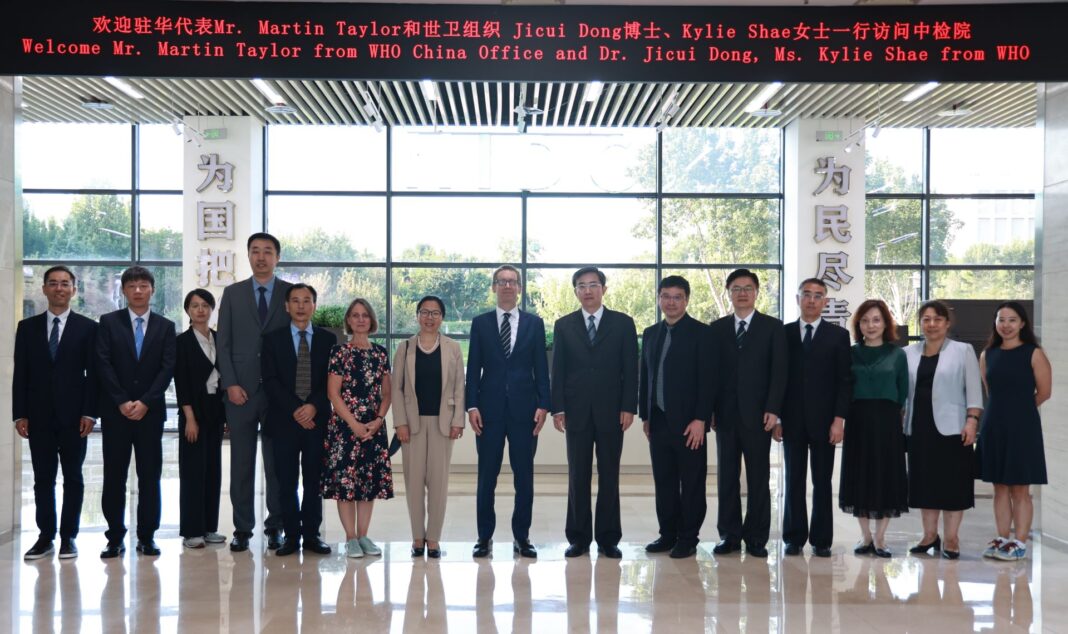
Senior representatives from WHO, NIDC and China’s National Medical Products Administration attended the exchange.
WHO’s delegation included Taylor, Dr Jicui Dong, Head of the Products Policies, Access and Manufacturing Support Unit, and Kylie Shae, Team Lead for Access to Medical Devices and Assistive Technology.
Shae will coordinate WHO’s operational support, working with colleagues across the organisation and technical counterparts at NIDC.
WHO acknowledged the leadership of NIDC, the support of the National Medical Products Administration and the contributions of technical teams from both institutions.
The organisations will now work to translate the agreed areas of cooperation into practical activities that support countries in strengthening diagnostic quality and access.