
Only 12.9% of health facilities across Africa offered youth-friendly services in 2025, while six in 10 countries could not track spending on adolescent sexual and reproductive health.
Africa’s efforts to achieve health sovereignty are being undermined by inadequate investment in adolescent healthcare and the exclusion of young people and women from decisions that shape the continent’s health systems, according to a new report by the Africa Centres for Disease Control and Prevention (Africa CDC).
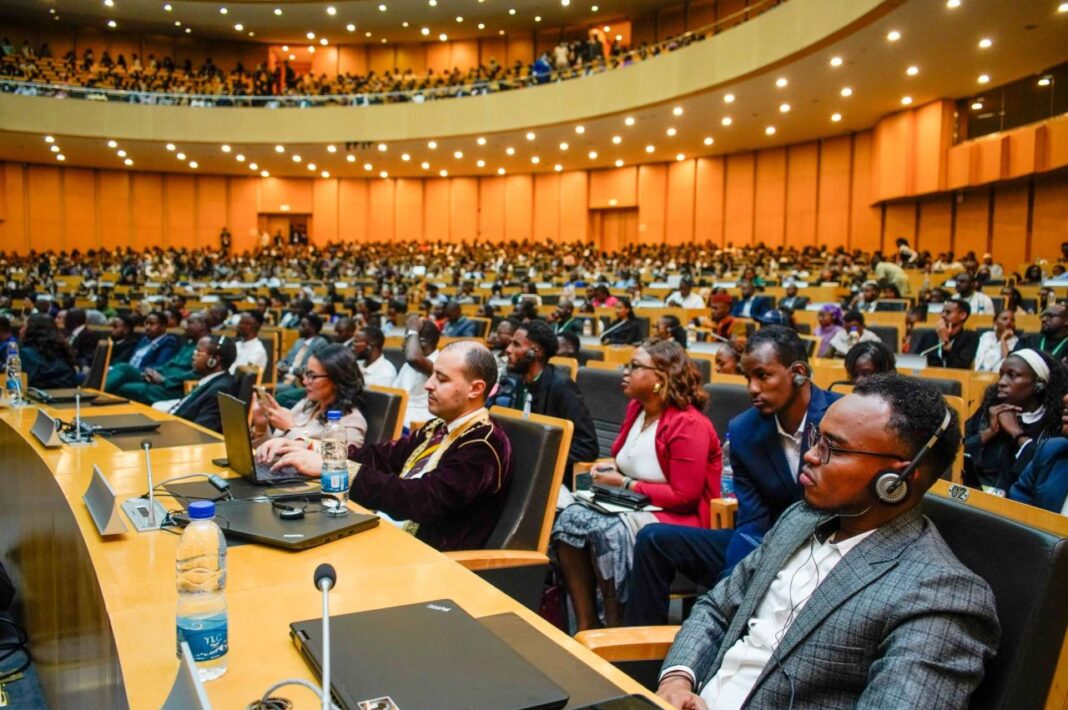
The report, Seen, Served and Counted: The State of Adolescent Health in African Union Member States, was launched on 22 November during the inaugural Africa CDC Youth Pre-Conference and Women in Health Leadership Summit at the African Union Commission headquarters in Addis Ababa.
Drawing on information provided by the health ministries of all 55 African Union Member States, the report identifies a persistent gap between commitments to adolescent health and the delivery of essential services.
Only 12.9% of health facilities offered youth-friendly services in 2025, a figure that has barely changed since 2021.
The findings raise concerns about whether young people can access healthcare that responds to their specific needs, particularly sexual and reproductive health services.
The report also found that adolescent girls account for 16.5% of all pregnancies across Africa, with the proportion rising to 24.2% in Southern Africa.
Pregnancies among girls aged 10 to 14 remain particularly difficult to measure, with the report indicating that these cases are largely hidden from available data.
The findings point to a wider challenge facing African health systems: while policies for adolescent healthcare exist across the continent, their implementation remains inconsistent.
- Health budgets leave adolescents behind
The report highlights a significant gap in how governments finance and monitor adolescent health services.
Six in 10 African countries cannot establish how much they spend on adolescent sexual and reproductive health.
Without clear expenditure data, governments face difficulties determining whether available resources match the needs of young people or identifying where additional investment is required.
The report calls for adolescent health spending to be tracked in national budgets, alongside stronger accountability for the delivery of essential services.
It recommends that every primary healthcare facility adopt standards for adolescent-friendly services and that barriers related to consent and confidentiality be addressed.
It also calls for every pregnancy involving a girl aged 10 to 14 to be treated as a child protection case, strengthening the response to the needs and protection of very young adolescents.
Despite the gaps, the report identifies some progress.
Modern contraceptive use among girls aged 15 to 19 increased from 14.0 to 17.1 per 100 between 2021 and 2025.
However, the report’s findings suggest that improvements in individual indicators have not yet translated into widespread access to youth-friendly healthcare.
Young people and women demand influence over health decisions
The report was launched at a summit designed to bring young people and women leaders into discussions on health financing, leadership and policy implementation.
The event, held ahead of the Conference on Public Health in Africa (CPHIA 2026), brought together government representatives, youth champions, women leaders, development partners, investors and civil society.
It marked a shift from previous CPHIA youth gatherings, which had taken place largely on the margins of the conference.
Africa CDC Director-General Dr Jean Kaseya said young people and women must have a meaningful role in shaping and financing health systems.
“Africa’s youth and women do not need permission to lead. They need the room, the genuine support, the budget and the seat they so rightfully deserve,” he said.
Women account for approximately 70% of Africa’s health workforce, while adolescents aged 10 to 19 represent about one in four Africans.
Despite their contribution to healthcare delivery and the size of the adolescent population, both groups remain largely excluded from leadership and budget decisions, according to Africa CDC.
The summit was organised through collaboration between Africa CDC’s Youth Division and its Reproductive, Maternal, Newborn, Child and Adolescent Health and Sexual and Reproductive Health and Rights Division.
The organisers sought to move beyond discussions and establish commitments that could be monitored over time.
From declarations to measurable commitments
A high-level panel on sustainable health financing for women, adolescents and young people brought together representatives from the World Bank, Global Leaders Network, UNFPA, UNICEF, the AHF, ECSA, Pathfinder International and Africa CDC.
Participants were asked to identify concrete commitments to support the health priorities of women and young people.
Five parallel working groups then developed priority actions covering sexual and reproductive health, HIV and adolescent mental health; health workforce development and leadership; digital health and research; One Health and emergency preparedness; and local manufacturing of health products.
Each group agreed on three priority actions, with designated leads and timelines.
The Global Leaders Network, AHF Global Public Health Institute, Norway Public Health Institute and Pathfinder International announced pledges and signed a public Commitments Register.
Their commitments include supporting implementation of the African Union Champion’s Roadmap for Reproductive, Maternal, Newborn, Child and Adolescent Health 2026–2030.
They also pledged to promote meaningful youth engagement and ensure that the priorities of women, children and adolescents are reflected in global health reform discussions.
The summit concluded with the adoption of a Joint Leadership Declaration, which will be presented at CPHIA 2026.
Africa CDC said it would publicly report on progress against the commitments.
Youth Champion Ivy Nduta Mureith said the summit had provided young people with an opportunity to set priorities and secure institutional commitments.
She said youth representatives would hold signatories accountable for delivering on the promises made at the summit.
A call for governments to act
The report’s recommendations were reinforced by Tanzanian President Samia Suluhu Hassan, African Union Champion for Maternal, Newborn and Child Health, whose foreword called on member states to adopt the seven recommendations.
She urged governments to report adolescent health data in full, disaggregated by age group, and protect domestic financing for essential services.
The summit was also guided by the leadership of President Hassan, represented by the Head of the AU Champion’s Secretariat, Ummy Mwalimu, and recognised the leadership of South African President Cyril Ramaphosa, represented by Dr Lwazi Manzi.
Former Ugandan Vice-President Specioza Kazibwe also addressed the gathering.
The event received financial support from the AU Champion Secretariat for Maternal and Child Health, Global Leaders Network, UNFPA, UNICEF, WHO, the World Bank, AHF Global Public Health Institute, ECSA Health Community and Pathfinder International.
For Africa CDC, the challenge now is to ensure that the commitments translate into improved services, stronger investment and greater representation of young people and women in health leadership.
The report’s central finding is that Africa’s adolescent health challenge is not simply a shortage of policies. It is the gap between what governments have promised and what young people can access.