As chronic diseases and healthcare costs rise globally, experts are calling for stronger scientific research into how food, nutrition and traditional knowledge can contribute to disease prevention and healthier populations.
Long before food became the subject of scientific studies, communities relied on generations of knowledge about what they ate, how they prepared it and the role different foods played in maintaining health.
Across Africa and other parts of the world, traditional diets have been shaped by locally available foods, cultural practices and knowledge passed down through generations.
But as dietary patterns change, chronic diseases increase and healthcare systems face mounting pressure, attention is turning to an important question: could food and traditional knowledge play a greater role in preventing disease?
This question took centre stage at the second FoodMed Conference, held on 5–6 November 2026 at Hong Kong Baptist University, where international researchers, regulators, healthcare professionals, industry leaders and investors explored the growing field of Food as Medicine.
Held under the theme Deepening Translation and Impact, the conference examined how traditional knowledge, scientific research and technological innovation can work together to improve health and wellbeing.
The discussions came at a time when health systems are increasingly recognising the importance of prevention rather than relying primarily on treating diseases after they develop.
For populations experiencing rising chronic disease burdens, the potential contribution of food and nutrition to health promotion has become an important area of research.
However, experts emphasised that traditional knowledge must be supported by scientific evidence, responsible innovation and appropriate regulation before it can be translated into practical healthcare interventions.
Moving traditional knowledge into modern healthcare
In a video message, Dr Sylvie Briand, Chief Scientist and Assistant Director-General for Health Systems, Access and Data a.i. at the World Health Organization (WHO), highlighted the importance of prevention and health promotion in shaping future health systems.
She pointed to the WHO Global Traditional Medicine Strategy 2025–2034, which calls for the integration of safe and effective traditional, complementary and integrative medicine into health systems based on scientific evidence.
The strategy underscores the importance of bringing traditional knowledge and rigorous scientific research together when examining the relationship between food and health.
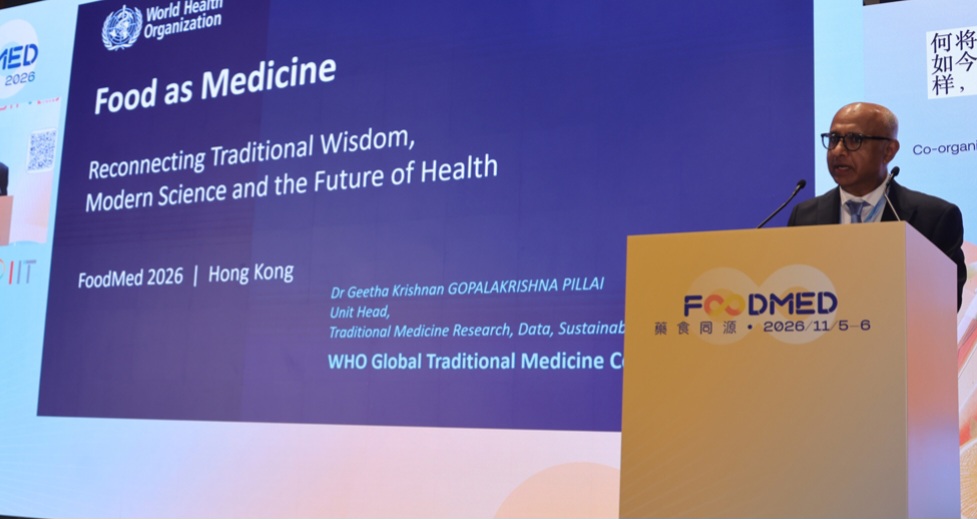
Representing the WHO Global Traditional Medicine Centre (GTMC), Dr Geetha Krishnan Gopalakrishna Pillai, Unit Head for Traditional Medicine Research, Data, Sustainability and Innovation, delivered a keynote titled Food as Medicine: Reconnecting Traditional Wisdom, Modern Science and the Future of Health.
His presentation explored how scientific evidence generation, responsible innovation, appropriate regulation and digital knowledge platforms could help translate traditional knowledge into measurable public-health outcomes.
The emphasis is significant because traditional food practices are not automatically safe or effective simply because they have been used for generations.
Scientific research is necessary to establish which practices offer measurable health benefits, identify potential risks and determine how they can be responsibly incorporated into healthcare systems.
The evidence gap
One of the challenges facing the Food as Medicine movement is the need for stronger research.
While traditional medicine and food-based health practices are attracting growing international interest, gaps in scientific evidence continue to limit their integration into mainstream health systems.
At the conference, Professor Amie Steel of Southern Cross University presented findings from WHO’s recently launched global research priorities initiative.
The report identified important evidence gaps and called for increased investment in traditional medicine research to better respond to changing global health needs.
It also provides a strategic framework to help governments, research institutions and funding agencies align their investments with public-health priorities.
For healthcare professionals and policymakers, the challenge is ensuring that interest in traditional approaches translates into interventions supported by credible evidence rather than assumptions or unverified health claims.
WHO’s Global Traditional Medicine Centre also showcased its Traditional Medicine Global Library during the conference, highlighting efforts to improve access to scientific, technical and policy information that can support research, policymaking and innovation.
Why the conversation matters for public health
The growing interest in Food as Medicine reflects a wider shift towards preventive healthcare.
As populations age and chronic diseases place increasing demands on healthcare budgets, the ability to identify and promote effective preventive interventions is becoming increasingly important.
Food and nutrition are central to this discussion, although their health benefits depend on dietary patterns, nutritional quality, individual needs and wider social and economic conditions.
For communities, access to nutritious food is also influenced by affordability, food systems, cultural practices and availability.
This means that promoting healthier diets cannot be separated from broader questions about food security, public education and equitable access to nutritious foods.
The discussions at FoodMed 2026 therefore extend beyond the scientific relationship between food and health. They raise questions about how research findings can reach communities, inform public-health policies and support healthcare professionals in making evidence-based recommendations.
Ultimately, traditional knowledge and modern science do not have to compete.
When supported by rigorous research, responsible regulation and collaboration, they can contribute complementary perspectives to disease prevention and health promotion.
The challenge ahead is ensuring that the growing enthusiasm for Food as Medicine produces credible evidence and practical benefits for populations, rather than remaining an attractive concept discussed at international conferences.