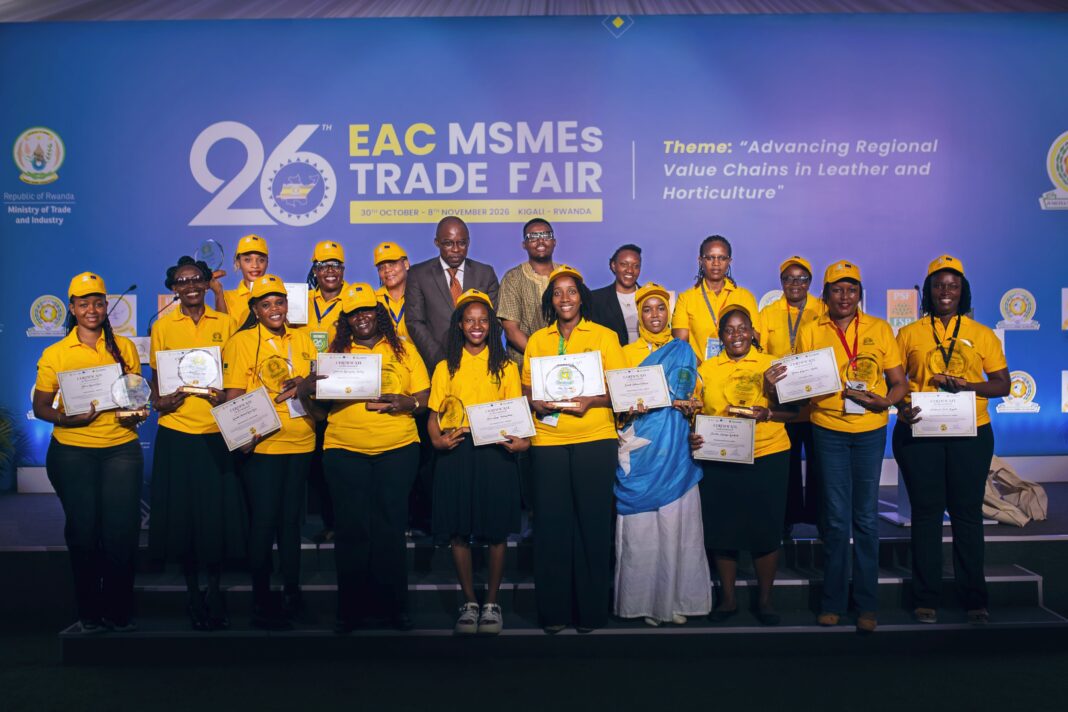

Sixteen women entrepreneurs from across the East African Community (EAC) are strengthening their businesses and positioning themselves to tap into the region’s growing trade opportunities following a mentorship and capacity-building programme aimed at increasing women’s participation in cross-border commerce.
The entrepreneurs, drawn from all eight EAC Partner States, completed six months of mentorship and business development under the East African Women in Trade Champions Initiative (EAWiTCI), which seeks to address barriers limiting women’s participation in regional and international trade.
The programme culminated in recognition of the 16 entrepreneurs at the 26th EAC Micro, Small and Medium Enterprises (MSMEs) Trade Fair in Kigali, Rwanda, providing a platform to highlight their progress and connect them with wider regional business opportunities.
The initiative comes as East African countries seek to deepen economic integration, expand intra-regional trade and strengthen the contribution of micro, small and medium enterprises (MSMEs) to economic growth, employment creation and industrial development.
Through the mentorship programme, participants acquired practical knowledge of EAC trade policies, cross-border trading procedures and regional market requirements, equipping them with skills to navigate the business environment beyond their domestic markets.
Understanding customs procedures, trade regulations and market access requirements is particularly important for women-led enterprises seeking to expand across borders, where administrative barriers, limited access to business information and inadequate commercial networks can constrain growth.
By addressing these challenges, EAWiTCI is seeking to transform women-owned businesses from predominantly local enterprises into more competitive regional players capable of accessing new customers, suppliers and investment opportunities.
Beyond technical training, the initiative has placed emphasis on building business networks and strengthening the entrepreneurial capabilities of participants, recognising that access to markets, business connections and reliable information is essential for enterprise expansion.
The 16 entrepreneurs are expected to use the knowledge and experience gained to grow their respective businesses while supporting other women seeking to enter regional trade.
Under the programme’s multiplier approach, the participants will serve as champions in their countries, sharing knowledge, mentoring emerging women entrepreneurs and creating networks that can facilitate greater participation in cross-border business.
This model is intended to extend the programme’s impact beyond the initial group of beneficiaries, creating a wider network of women equipped to identify trade opportunities, overcome business barriers and participate in regional value chains.
Women’s economic empowerment remains an important component of East Africa’s development agenda, particularly given the significant role played by MSMEs in supporting livelihoods, creating employment and sustaining local economies.
However, women entrepreneurs continue to face challenges in accessing finance, business development services, market information and established commercial networks. These constraints can limit their ability to scale operations, meet larger orders and compete effectively in regional markets.
Initiatives that combine mentorship, technical training and market linkages therefore offer an important pathway towards addressing some of these structural challenges.
For the EAC, strengthening women-led enterprises also presents an opportunity to expand the region’s productive capacity and diversify its trade base. More competitive women-owned businesses can contribute to manufacturing, agribusiness, services and other sectors while supporting regional supply chains.
The recognition at the Kigali trade fair also highlights the importance of connecting capacity-building programmes with commercial platforms where entrepreneurs can showcase their products, establish partnerships and explore potential markets.
As regional integration gains momentum, the ability of small businesses to operate across national borders will be critical in translating policy commitments into tangible economic benefits for communities.
Through EAWiTCI, the EAC is seeking to ensure that women are not merely beneficiaries of regional integration but active participants in shaping its commercial future.
By equipping women entrepreneurs with trade knowledge, business skills and regional networks, the initiative aims to create a new generation of business leaders capable of expanding enterprises, generating employment and strengthening East Africa’s competitiveness.
Ultimately, empowering women to trade across borders is not only a gender equality objective but also an economic strategy for building a more inclusive, productive and integrated East African market.