

Despite widespread policies on adolescent sexual and reproductive health, only 12.9 per cent of African health facilities offered youth-friendly services in 2025, while pregnancies among girls aged 10 to 19 accounted for 16.5 per cent of all pregnancies in countries able to report data.
Africa’s adolescent health crisis is not simply a question of whether governments have policies to protect young people. It is increasingly a question of whether those policies translate into services that adolescents can access, afford and trust.
A new continental assessment by the Africa Centres for Disease Control and Prevention (Africa CDC) has exposed the gap between political commitments and the realities facing millions of young people, particularly adolescent girls seeking sexual and reproductive health services.
The report, Seen, Served and Counted: The State of Adolescent Health in African Union Member States, found that only 12.9 per cent of health facilities across reporting countries offered adolescent- and youth-friendly services in 2025.
The figure has barely changed since 2021, despite 83 per cent of responding countries having national policies on adolescent sexual and reproductive health.
The findings suggest that the existence of policies does not necessarily guarantee that young people can obtain the services those policies promise.
For adolescents, the difference can determine whether they receive timely health information, access contraception, seek care during pregnancy or obtain support without fear of discrimination.
The assessment, launched on November 22 at the African Union Commission headquarters in Addis Ababa, Ethiopia, draws on information submitted by the Ministries of Health of all 55 African Union Member States.
It examines adolescent health policies, financing, service delivery and monitoring between 2021 and 2025.
Among countries able to report the relevant figures, pregnancies among girls aged 10 to 19 accounted for 16.5 per cent of all pregnancies. In Southern Africa, the proportion reached 24.2 per cent, or almost one in four pregnancies.
The share declined only slightly from 17.9 per cent in 2021, indicating that progress has been slow.
However, the report warns that the recorded figures may not capture the full extent of adolescent pregnancy, particularly among the youngest girls.
Pregnancies among girls aged 10 to 14 accounted for just 1.8 per cent of recorded adolescent pregnancies, compared with a World Health Organization estimate of 5.2 per cent.
The discrepancy raises concerns about whether health systems are adequately identifying and responding to pregnancies among younger adolescents.
Africa CDC Director General Jean Kaseya said the assessment was intended to expose the gaps preventing countries from translating policies into effective services.
“What we cannot measure, we cannot manage, and what we cannot show, we cannot finance,” Kaseya said.
The report identifies inadequate financing, workforce shortages and weak data systems as major obstacles to improving adolescent health.
Insufficient funding was cited by 73 per cent of countries, while 71 per cent identified shortages of health workers and 63 per cent reported weaknesses in their data systems.
The financing gap is particularly significant because 60 per cent of countries could not establish how much they spent on adolescent sexual and reproductive health.
Without clear expenditure data, governments face difficulties determining whether resources allocated to adolescent health are reaching the intended services and populations.
The assessment also found that 37 per cent of countries did not routinely disaggregate their health data by age.
This means that the needs of adolescents can become obscured within broader national health statistics, making it harder to identify service gaps and measure whether interventions are reaching young people.
For girls experiencing pregnancy at an early age, the consequences of being overlooked can extend beyond healthcare.
In her foreword to the report, Tanzania’s President and African Union Champion for Maternal and Child Health, Samia Suluhu Hassan, warned that the limited number of recorded pregnancies among girls aged 10 to 14 should not be interpreted as evidence that younger girls are safer.
“I do not believe our youngest girls are safer than we thought. I believe they are hidden,” she said.
The report recommends treating every pregnancy among girls aged 10 to 14 as a child protection case, alongside stronger action against child marriage and efforts to keep girls in school.
It also calls for the removal of consent and confidentiality barriers that prevent adolescents from accessing sexual and reproductive health services.
Almost one in four countries reported having no confidentiality protections for adolescents.
For young people, the absence of such protections can create uncertainty about whether seeking care will expose private information to parents, guardians or other people.
Youth Champion Ivy Nduta Mureith said the findings reflected challenges that young people already experience when attempting to access health services.
“The clinic down the road was not built for us,” she said, calling for accessible services, transparent budgets and greater youth participation in decision-making.
The assessment nevertheless identifies areas where progress has been recorded.
Modern contraceptive use among girls aged 15 to 19 increased from 14.0 to 17.1 per 100, while early postnatal care rose from 57 per cent to approximately 62 per cent of mothers.
Africa CDC is calling on Member States to integrate adolescent-friendly standards into primary healthcare facilities, establish national service delivery targets and report progress annually.
Other recommendations include expanding access to contraception, tracking adolescent sexual and reproductive health expenditure in national budgets and improving the collection of age- and sex-disaggregated data.
The agency has also committed to supporting countries in implementing the recommendations and repeating the assessment to measure progress.
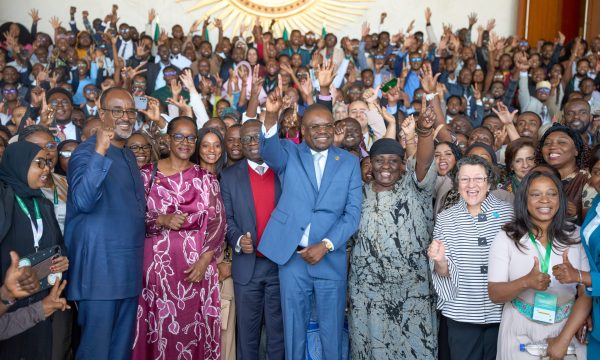
The findings were presented during the Africa CDC Youth Pre-Conference and Women in Health Leadership Summit, held ahead of the Conference on Public Health in Africa 2026.
The summit brought together more than 2,500 young people, women leaders, health ministers, African Union institutions and development partners.
Participants signed a public Commitments Register and adopted a Joint Leadership Declaration for presentation at the conference.
The commitments are intended to move the discussions beyond policy statements towards practical action.
For Africa’s adolescents, the challenge now is whether governments can turn those commitments into health facilities that are equipped, adequately funded and accessible to young people.
The next assessment will need to show not only whether more countries have policies, but whether more adolescents can actually use the services those policies promise.