
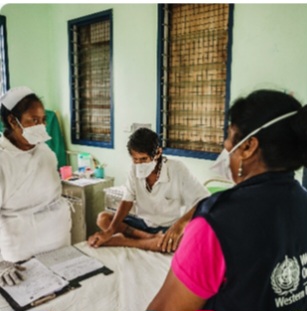

Nearly half of people receiving treatment for tuberculosis (TB) and their households face catastrophic costs associated with the disease, highlighting the financial burden that can undermine treatment and push already vulnerable families into deeper hardship.
The World Health Organization (WHO) and the International Labour Organization (ILO) report that 47 per cent of people treated for TB and their households in countries that have conducted national TB household cost surveys experience catastrophic costs.
The expenses include the cost of accessing and completing treatment, alongside lost income and employment opportunities as patients struggle to manage the disease.
To address the challenge, the two United Nations agencies have introduced a new monitoring and evaluation framework to help countries assess whether people affected by TB are receiving adequate health and social protection benefits.
Published on October 21, 2026, the framework seeks to turn international commitments into measurable progress by helping governments identify gaps in social protection coverage and improve support for patients and their families.
At the 2023 United Nations General Assembly High-Level Meeting on TB, member states committed to ensuring that 100 per cent of people with TB have access to a package of health and social benefits by 2027.
With the deadline approaching, the new framework offers countries a practical way to measure progress towards the target.
When TB becomes a financial crisis
Beyond its medical consequences, TB can create significant economic challenges for patients and their households.
Treatment-related expenses, transport costs and lost earnings can place pressure on families, particularly when illness interferes with their ability to work.
For households already struggling financially, these pressures can make accessing and completing care more difficult, reinforcing the need for health interventions to be accompanied by social and economic support.
Social protection measures can help reduce this burden by connecting people affected by TB to relevant health benefits and other forms of assistance.
However, making these benefits available does not automatically mean that every eligible patient receives them. Governments must also establish whether support reaches the intended beneficiaries, arrives when needed and adequately addresses their circumstances.
Dr Tereza Kasaeva, Director of WHO’s Department for HIV, Tuberculosis, Hepatitis and Sexually Transmitted Infections, said the framework would help countries determine whether people with TB are effectively reached by health and social benefits.
She urged governments and partners to use the new approach to accelerate progress towards the 2027 target.
Linking healthcare to social protection
The framework adopts a phased approach that countries can implement according to their existing social protection systems, available data and monitoring capacity.
Rather than requiring every country to establish an entirely new monitoring system, it allows governments to build on existing health and social protection mechanisms while progressively improving their ability to measure effective coverage.
The approach is intended to help countries identify populations missing out on assistance, strengthen programmes and improve coordination between health and social protection authorities.
Shahra Razavi, Director of the ILO’s Labour and Social Protection Department, said universal social protection was critical to shielding people with TB and their families from the economic consequences of illness.
She emphasised the importance of strengthening links between social protection systems and healthcare services to ensure that people affected by TB are included.
The framework complements WHO and ILO guidance published in 2024 on social protection for people affected by TB, providing a practical mechanism for tracking progress and identifying shortcomings.
The 2027 target
The new framework comes as countries face the challenge of translating commitments to end TB into policies that address both the disease and the conditions that make it harder for patients to recover.
By combining health and social protection monitoring, WHO and ILO aim to strengthen accountability and encourage coordinated action across sectors.
The initiative also supports WHO’s Multisectoral Accountability Framework to end TB, which promotes collective responsibility for progress against the disease.
Achieving universal social protection for people with TB will require governments to move beyond measuring whether benefits exist to determining whether patients can actually access them.
As the 2027 deadline approaches, the effectiveness of the new framework will depend on how countries use its findings to close coverage gaps and improve support.
For patients and their families, the goal is clear: receiving treatment for TB should not come at the cost of financial hardship, lost livelihoods or diminished economic security.