
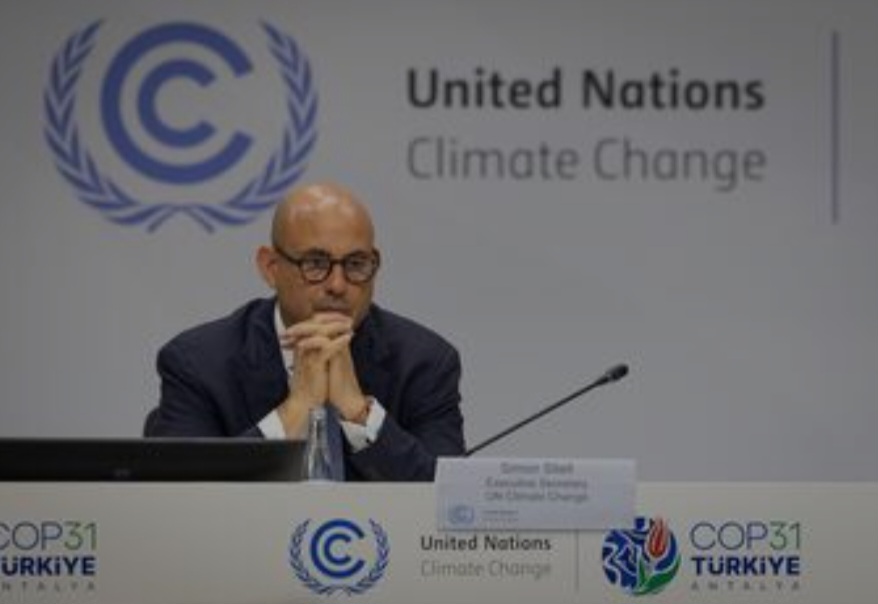

The failure of governments to agree on a final climate pact at COP31 has exposed deep divisions over the future of fossil fuels, leaving vulnerable nations facing renewed uncertainty over climate action and financial support.
The United Nations climate summit in Antalya, Türkiye, concluded on Sunday, November 22, after two weeks of negotiations and two additional days of talks failed to produce consensus on the conference’s main political decisions.
UN Secretary-General António Guterres described the outcome as “deeply disappointing”, warning that the collapse of negotiations should not be mistaken for a reduction in the urgency of the climate crisis.
“There may be no consensus in the negotiating room. There is no ambiguity in the science,” Guterres said in a statement following the summit.
The failure to reach agreement came as governments struggled to reconcile competing positions on fossil fuels, with countries divided over whether the final text should explicitly commit them to moving away from coal, oil and gas.
The disagreement prevented the adoption of a final climate pact, despite several attempts by the COP31 co-presidents, Türkiye and Australia, to bridge differences through revised drafts.
For Guterres, the outcome highlighted the growing disconnect between international climate negotiations and the action required to address rising global temperatures.
He warned that greenhouse gas emissions remain dangerously high, climate impacts are intensifying and the world is on course to exceed the internationally agreed 1.5°C warming limit.
“The take-home message from COP31 is clear: the world must do much more to confront the climate crisis – and it must do it now,” he said.
Guterres argued that fossil fuels remain the leading driver of global warming, cautioning against attempts to delay the transition to cleaner energy.
“We can’t put out the fire while pouring fuel on it,” he said, criticising powerful fossil fuel interests for obstructing climate action while continuing to profit.
The UN chief pointed to the agreement reached at COP28 in Dubai to transition away from fossil fuels, saying governments must now accelerate implementation and provide the financing required to make the shift possible.
He also called for deeper emissions reductions during the current decade, stronger climate adaptation measures and increased financial support for developing countries.
Without substantially greater investment, he warned, countries already experiencing severe climate impacts risk being left to shoulder the consequences of a crisis they contributed least to creating.
The failure to reach a final agreement was particularly significant for climate-vulnerable nations, which had pushed for stronger commitments on fossil fuel transition, climate finance and support for communities facing irreversible losses.
Several countries formally rejected the final draft, arguing that it weakened earlier commitments and failed to reflect the scale of the climate emergency.
The European Union said it could not accept a text that excluded any reference to fossil fuels or a transition away from them, describing the omission as “unconscionable”.
The bloc warned that the outcome risked widening the gap between governments’ climate promises and the action being taken to fulfil them.
Panama also rejected the draft, arguing that governments should focus on delivering climate action rather than negotiating the minimum level of ambition.
The delegation said the text weakened previously agreed decisions and failed to keep the 1.5°C goal within reach.
The Marshall Islands, among the countries most exposed to rising sea levels, also withheld its support, warning that the agreement failed nations on the front lines of climate change.
The delegation argued that faster movement away from fossil fuels, supported by stronger financial commitments, remained essential to protecting vulnerable populations.
The disagreement over the final text reflected competing priorities among countries, including those seeking a stronger commitment to phase out fossil fuels and those concerned about the economic consequences of reducing dependence on coal, oil and gas.
Türkiye’s Environment Minister and COP31 President Murat Kurum acknowledged that governments had failed to reach agreement.
“I understand that there is no agreement on this text. For that reason, these decisions have not been adopted,” he said.
The negotiations had been extended by two days as delegates attempted to resolve the impasse.
Compromise proposals circulated by Türkiye and Australia sought to address concerns across the negotiating blocs, including by acknowledging that global warming is on course to exceed the 1.5°C threshold and calling for expanded carbon-removal technologies.
However, critics argued that the proposed language weakened previous commitments and did not reflect the urgency of reducing emissions.
The African Group, represented by Ghana, acknowledged shortcomings in the final text, particularly on climate finance, loss and damage, and the just transition.
Ghana said the agreement devoted only a single generic sentence to the just transition, a process intended to support workers and communities as economies move towards cleaner energy.
Despite these concerns, the African Group said it would not block consensus, arguing that the text reflected the views of a broad range of countries.
Pakistan similarly urged governments to preserve cooperation, warning that climate action required “bridges, not barriers”.
The delegation said some aspects of the draft remained problematic but maintained that the wider package should not be abandoned.
Saudi Arabia defended the inclusion of carbon capture and storage in the negotiations, rejecting criticism that the technology represented greenwashing.
Representing the League of Arab States, the delegation argued that carbon capture and storage could contribute to limiting global warming and that viable climate solutions should remain under consideration.
Despite the absence of a final climate pact, the conference recorded progress in other areas.
UN Climate Change Executive Secretary Simon Stiell highlighted an agreement on a just transition and initiatives under the COP31 Action Agenda aimed at accelerating electrification, strengthening resilience and increasing investment.
However, he warned that governments must learn from the failure to reach consensus on the summit’s central political decisions.
“The world cannot afford a repeat of this moment,” Stiell said during the closing plenary.
He urged countries to build on previous climate commitments rather than reverse progress made through international negotiations.
The summit’s conclusion also renewed attention on the gap between climate commitments and implementation, particularly for developing countries seeking financial support to reduce emissions and adapt to increasingly severe climate impacts.
Guterres said the real measure of progress would be whether governments reduce fossil fuel dependence, expand clean energy, cut methane emissions, restore forests and deliver climate finance to developing nations.
He also urged civil society organisations, young people, Indigenous Peoples, scientists and communities on the front lines of climate change to continue demanding accountability from governments.
“The climate crisis will not wait for governments to find common ground. Neither can we,” he said.
The failure to agree on a final pact now shifts attention to COP32, scheduled to take place in Addis Ababa, Ethiopia, where governments will face unresolved questions over fossil fuel transition, climate finance and the level of ambition needed to confront the climate crisis.
For countries already grappling with the consequences of global warming, the outcome of COP31 leaves a pressing challenge: turning years of climate commitments into action that reaches the communities most at risk.