
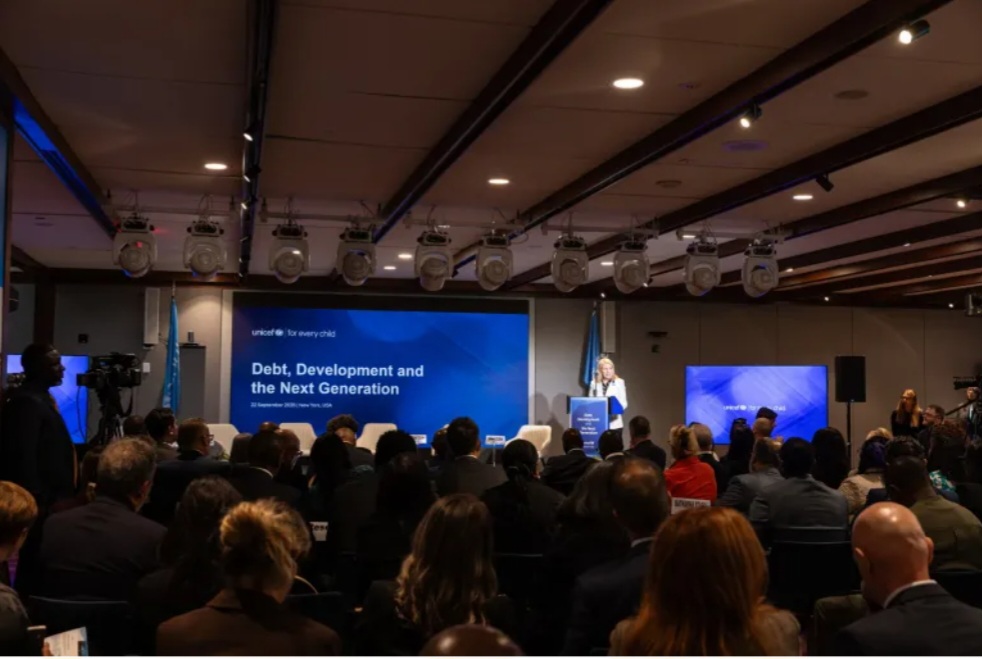

UNICEF Executive Director Catherine Russell told government leaders, creditors and development partners gathered at UNICEF House on Monday that the global debt crisis has become a “generational crisis,” with rising public debt now directly undermining children’s health, education and nutrition in dozens of low- and middle-income countries.
Speaking alongside Kenyan President William Ruto and Barbados Prime Minister Mia Mottley, Russell said more than a billion children are growing up in countries where debt service is crowding out spending on essential services. She noted that in some nations, external debt service has more than doubled as a share of government revenue since 2010 — climbing from roughly 4 percent to over 10 percent.
The figures Russell cited were stark: in 2024, countries in or near debt distress paid out more than $30 billion to external creditors than they received in new financing. In 34 countries home to 1.1 billion children governments now spend more on interest payments than on health. Those same countries, she said, account for an estimated 3.2 million deaths of children under five and 97 million cases of childhood stunting.
Russell argued that the core flaw in the current debt system is one of timing. “Debt can be rescheduled. Childhood cannot be rescheduled,” she said, pointing out that missed vaccinations, poor early childhood nutrition and lost years of schooling cannot simply be recovered once a country’s fiscal position improves. While creditors may spend years negotiating debt restructuring, she said, those same years represent irreplaceable stages of a child’s development.
Invoking UNICEF’s 1980s-era report Adjustment with a Human Face, which challenged the austerity orthodoxy of that period, Russell said the organization’s original argument that human outcomes shouldn’t be sacrificed for short-term economic goals remains relevant today. But she pushed the case further, arguing that investing in children isn’t merely compatible with debt sustainability but is a component of it: cutting health and education spending weakens the future workforce and tax base a country needs to service its debt in the long run.
She pointed to the pandemic-era Debt Service Suspension Initiative and Zambia’s post-default recovery which included expanded school enrollment and teacher hiring following IMF-backed restructuring as evidence that fiscal relief can translate quickly into gains for children when there’s political will.
Russell closed by posing three questions for the gathered officials to address: how debt relief can be delivered fast enough to matter for children, how debt sustainability assessments might better account for the long-term returns of investing in children, and how governments’ capacity to protect those investments during adjustment periods can be strengthened.
“Children cannot wait for us to get this right,” she said.